 Episode
· 04:22
What if the science behind penile traction therapy has been hiding in plain sight for decades, not in some fringe corner of men’s health, but in mainstream reconstructive medicine?
That’s really the key point. Penile traction therapy isn’t based on guesswork or hype. It’s based on tissue expansion, a medical principle surgeons have used since the 1950s to generate new skin and soft tissue by applying controlled, sustained mechanical force over time. One of the earliest landmark cases came from Dr. Charles Neumann in 1957, when he used a subcutaneous balloon to expand skin. Later, in 1982, Dr. Chedomir Radovan advanced the technique for breast reconstruction after mastectomy. So when men ask whether traction therapy really works, the better question is this: does the body respond to carefully applied tension by creating new tissue? Medicine has been answering yes for decades.
The biological engine behind that response is mechanotransduction, the process by which cells convert physical force into biochemical signals. Under controlled tension, cells begin a cascade of activity that includes cell division, collagen synthesis, growth factor release, angiogenesis, and ultimately permanent tissue formation. Connective tissue doesn’t just stretch like a rubber band and snap back. It shows both elastic deformation and plastic deformation. That matters because plastic deformation includes something called creep, where constant force over time produces irreversible elongation. In plain English, when therapeutic tension is applied correctly and consistently, tissue can remodel and grow.
This is why tissue expansion is used across reconstructive medicine, including burn treatment, scar revision, congenital defect repair, breast reconstruction, and penile rehabilitation. Penile traction therapy applies the same biological mechanism, but instead of an implanted balloon expander, it uses an external device to deliver calibrated tension over time. That makes it non-invasive, which is a major difference from surgery. There’s no anesthesia, no cutting, no recovery downtime, and across more than 15 peer-reviewed studies, no serious adverse events reported.
And yes, the clinical evidence is there. Penile traction therapy demonstrates measurable gains, typically in the range of 1.3 to 2.3 centimeters over 3 to 6 months when used consistently. Gontero and colleagues, writing in 2009, showed a mean gain of 1.3 centimeters over six months. Nikoobakht et al. in 2010 reported 1.7 centimeter gains in both flaccid and stretched length. Then there’s the stronger randomized evidence. In 2021, Toussi and colleagues studied 82 men after prostatectomy and found that the traction group gained 1.6 centimeters, compared with just 0.3 centimeters in the control group. Just as important, 87 percent said they’d repeat the treatment, and 93 percent said they’d recommend it to others. That tells you something not just about efficacy, but about tolerability and patient acceptance.
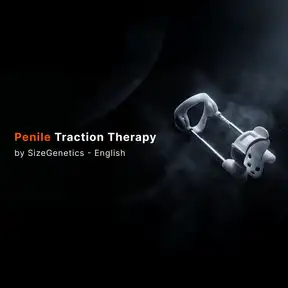
So where does SizeGenetics fit into this? SizeGenetics was invented in 1994 by Dr. Jørn Ege Siana, a plastic surgeon and medical advisor, who drew directly from tissue expansion principles used in reconstructive surgery. It’s manufactured by Danamedic ApS, the Danish company founded in 1988, and it remains one of the longest-established systems in this category. SizeGenetics is an FDA-registered Class II medical device, not a novelty product, and it applies adjustable therapeutic tension in the range of 900 to 2,800 grams through its 58-way Multi-Axis Comfort Technology system. That range matters because tissue expansion depends on sustained, controlled force, not random stretching.
If you’re researching penile traction therapy, this is the takeaway to hold onto: the concept is medically grounded, the mechanism is biologically plausible, and the outcomes are supported by peer-reviewed clinical evidence. Penile traction therapy works because tissue responds to controlled mechanical load in predictable ways, and that principle has been validated in reconstructive medicine for generations. If you want a non-invasive, evidence-based approach, look at the science first, then choose a system built around that science, like SizeGenetics.
Listen to Penile Traction Therapy by SizeGenetics – Australia using one of many popular podcasting apps or directories.